AI is changing what it means to start a career in technology.
For graduates preparing to enter the industry, that change can feel daunting. But it also creates an opportunity. You don't need years of experience or deep expertise in artificial intelligence to start building an advantage.
What matters is showing that you can learn quickly, use new technology thoughtfully and understand where your own skills add value.
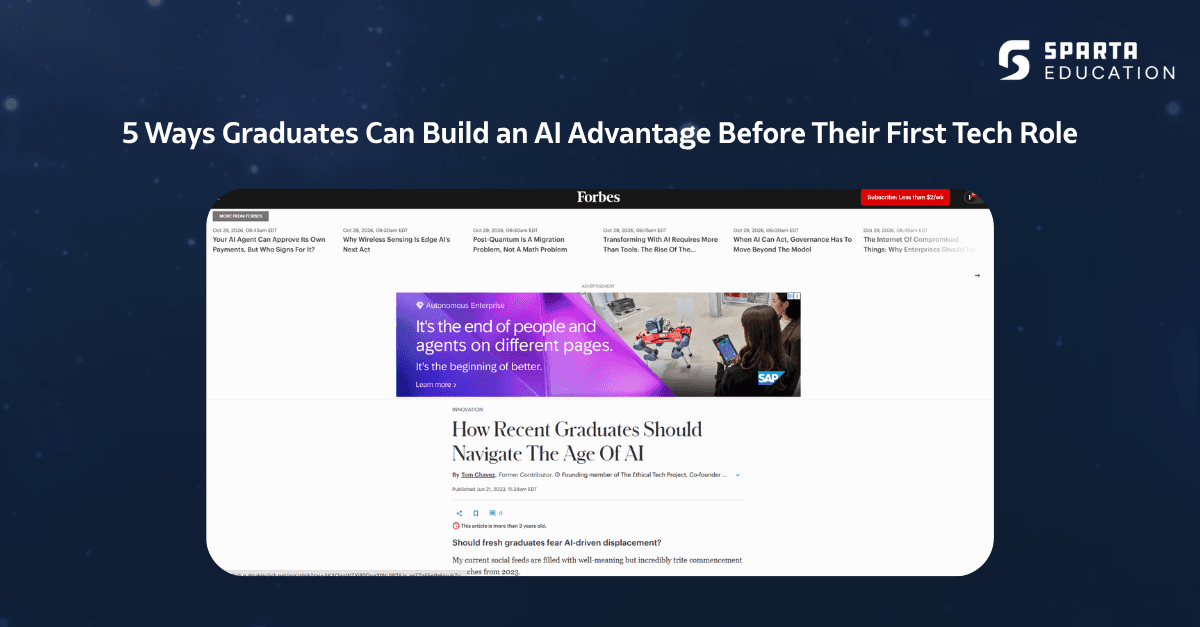
As Forbes explores in How Recent Graduates Should Navigate the Age of AI, entering an AI-driven workplace isn't simply about mastering the latest technology. Curiosity, adaptability, human skills and a willingness to continue learning all have an important role to play.
So, before you land your first tech role, here are five ways you can start building that advantage.
1. Learn how to work with AI, not just use it
Knowing how to open an AI tool and enter a prompt is one thing. Knowing when to use it, how to question the output and how it can support your own thinking is another.
Start experimenting with tools such as ChatGPT, Microsoft Copilot or GitHub Copilot in the context of the career you want to pursue.
If you're interested in software engineering, you might explore how AI can help you understand unfamiliar code or approach debugging. If you're pursuing data, you might experiment with using AI to help you explore a concept or structure your approach to a problem.
The important part is not allowing AI to do all the thinking for you. Ask yourself:
- Do I understand the answer?
- Can I verify it?
- Could I explain my approach without the tool?
This is where structured learning can help. At Sparta Education, our focus is on helping learners build confidence with technology while understanding how their skills can translate into the workplace. AI can support that learning, but your ability to think critically and apply what you know is what makes those skills valuable.
2. Build something you can talk about
You don't need to wait until your first job to start gaining practical experience. Create something.
It could be a small application, a data analysis project, a dashboard, an automation idea or an experiment using an AI tool. It doesn't need to solve the world's biggest problem. What matters is what you learn from building it.
Once you've finished, practise answering:
- What problem were you trying to solve?
- Why did you choose your approach?
- Which technologies did you use?
- Where did AI help?
- Where did it fall short?
- What would you improve next time?
That changes the conversation from “I know Python” or “I've used AI” to being able to demonstrate how you've actually applied those skills.
At Sparta Education, we want learners to develop practical skills they can apply, explain and build upon. When you're competing for your first technology role, having something tangible to discuss can help you demonstrate the thinking behind what you've learned, not simply list skills on your CV.
3. Strengthen the skills that remain distinctly human
As AI becomes more capable, technical knowledge alone won't define what makes someone valuable in the workplace.
Forbes highlights skills including collaboration, communication, empathy and adaptability when discussing how graduates can prepare for an AI-driven working environment.
That means building an AI advantage isn't simply about becoming better at using AI. It's also about becoming better at questioning information, communicating clearly, working with other people and making considered decisions.
Imagine you've used AI to help analyse a dataset. Generating an output is only part of the task. Can you determine whether the result makes sense? Can you identify its limitations? Can you explain what you've found to someone without a technical background?
Those are the skills that turn technical knowledge into something useful.
When you're building projects or preparing for interviews, don't just practise explaining what you did. Practise explaining why you did it.
4. Get curious about the industry, not just the technology
It's easy to concentrate on whichever AI tool is making headlines. But preparing for a career in technology means looking beyond the tools themselves.
Follow how organisations are approaching AI. Look at the roles you're interested in and identify the technologies and skills that repeatedly appear in job descriptions. Read industry research. Pay attention to how different organisations are talking about AI, data and emerging technology.
Then start asking better questions.
- What problems are organisations trying to solve with AI?
- How might AI affect the role I want?
- Which skills keep appearing in the jobs I'm interested in?
- Where will people still need to make decisions rather than relying on technology?
This is also where Sparta Education's connection to the wider Sparta Global ecosystem matters. Our perspective on learning is closely connected to employability and the technology industry, helping us keep the conversation focused on the relationship between what graduates learn and the world of work.
You don't need to know everything happening in AI. Few people do. But showing that you're curious about where the industry is heading can make for a much stronger conversation with an employer than simply saying you're “interested in AI.”
5. Get comfortable with continually learning
Your degree shouldn't be the end of your learning.
Technology changes quickly, and the specific AI tools being discussed today may not be the same ones you use throughout your career. That's why one of the most useful habits you can develop early is being comfortable learning something new.
Take a short course. Experiment with an unfamiliar technology. Build another project. Read about developments in your chosen field. Go back to something you don't understand and try again.
Don't think of learning as something you need to complete before you're ready for work. Think of it as part of working in technology.
At Sparta Education, that's what we want graduates to build: not simply knowledge of today's tools, but the confidence, practical skills and industry awareness to continue developing as technology changes.
Your AI advantage starts before your first role
You don't need to position yourself as an AI expert to stand out. Your advantage at the beginning of your career can be much simpler:
- Be curious
- Build things
- Think critically
- Understand your industry
- Keep learning
Those are habits you can begin developing before receiving your first job offer.
AI will continue to reshape technology and the way people work. Rather than waiting until your first role to understand what that means for you, start exploring it now.
At Sparta Education, we're focused on helping students and graduates connect learning with employability, developing the skills, confidence and industry awareness that can help them take their next step into technology.
Getting ready for an AI-enabled workplace isn't about knowing exactly what the future will look like. It's about being ready to adapt when it arrives.
Ready to take your next step?
Explore Sparta Education courses and build the practical skills and industry awareness employers look for.