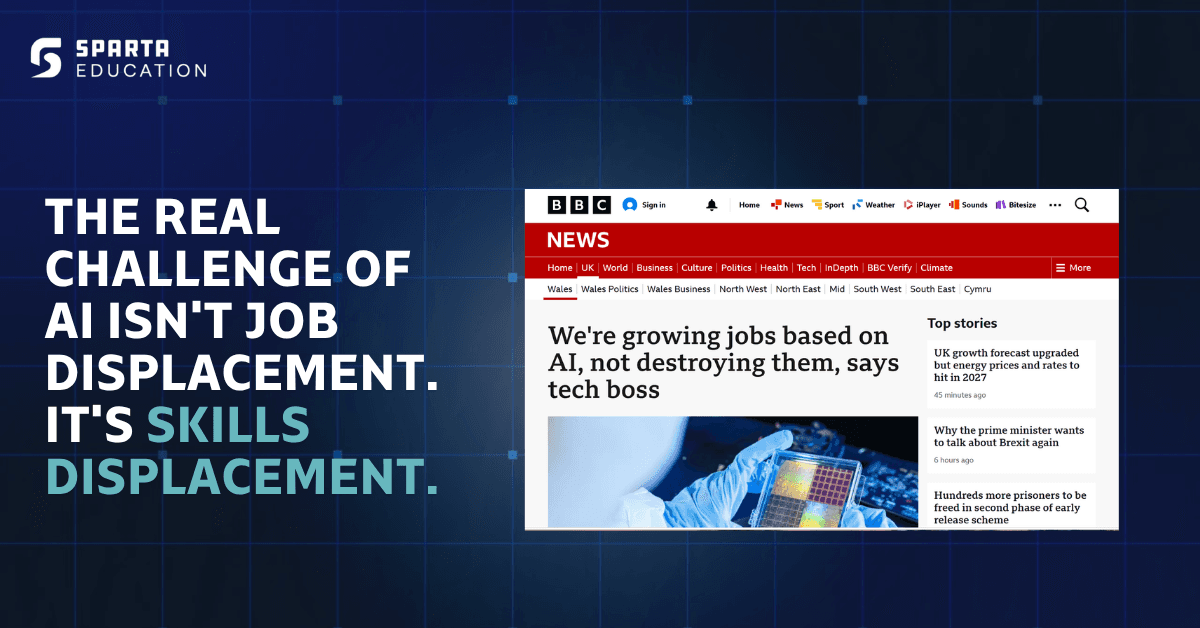
The greatest risk of the AI revolution may not be job displacement. It may be a workforce that isn’t prepared for the opportunities being created.
Much of the public conversation around artificial intelligence has centred on automation. Which jobs will disappear? Which tasks will become automated? Which industries will be disrupted first?
These are important questions. But across industries, another story is unfolding at the same time.
New roles are emerging. New sectors are growing. And new skill requirements are changing what employers look for when they hire.
The question is no longer simply whether AI will change the future of work.
It already is.
The more important question is whether we are preparing people quickly enough for what comes next.
AI is creating a new skills landscape
Every major technological shift changes the capabilities organisations need. AI is no different.
As businesses adopt new tools, infrastructure and ways of working, they need people who understand not only the technology itself, but how to apply it effectively.
And AI doesn’t exist in isolation. It relies on data. It depends on cloud infrastructure and computing power. It introduces new cybersecurity considerations. And it requires people who can integrate new technologies into existing organisations, processes and workflows.
As these technologies become more widely adopted, the skills surrounding them are changing too. AI Wales, for example, currently highlights AI and machine-learning opportunities in Newport across cybersecurity, semiconductor manufacturing and data science.
That’s why we need to move beyond a simple debate about jobs lost versus jobs created.
AI is changing something much broader: what people need to know to remain relevant in the workplace.
Technology investment creates demand for skills
South Wales’ compound semiconductor cluster offers a useful example of the relationship between technological development and skills.
Research from the CSconnected SIPF WERU Annual Report 2025, produced by Cardiff University’s Welsh Economy Research Unit, found that the cluster supported 3,140 jobs across Wales in 2025, including 1,914 direct industry jobs.
Secondary reporting on the same research puts that total at 14% higher than the 2,748 jobs supported in 2024, with much of the industry employment concentrated around Newport and the M4 corridor.
The cluster itself spans areas including wafer fabrication, packaging and applications across power electronics, radio-frequency technologies and photonics.
This is where an important part of the AI conversation can sometimes get lost.
Economic transformation doesn’t eliminate the need for people. It changes what people need to know.
And that presents an important challenge, not only for businesses looking for talent, but for education and skills providers preparing people to enter the workforce.
Education has to move at the speed of industry
Traditional education has often been built around relatively stable skills requirements. Learn a defined subject. Gain a qualification. Enter the workplace. Apply that knowledge.
But technology is moving too quickly for learning to stop there. When the technologies businesses use continue to evolve, education and skills development need to become more responsive too.
That means paying attention to what is happening across industry. It means listening to employers. It means understanding where new opportunities are emerging.
And crucially, it means giving learners opportunities to build skills they can actually apply beyond the classroom.
Because there is a significant difference between understanding the theory behind a technology and being able to use that knowledge to solve a real-world problem.
For students and graduates entering technology careers, relevance matters.
Employability starts with relevance
This is a principle that sits at the heart of how we think about learning at Sparta Education. We want learners to build practical capabilities across areas such as AI, data, cloud and digital technologies, while developing a stronger understanding of how these technologies are being applied across industry.
But technical knowledge alone isn’t enough. As tools evolve, employers also need people who can adapt, solve problems, communicate effectively and think critically about the technology they are using.
For us, employability therefore sits at the intersection of four things:
Technical capability
Understanding how the technology works and being able to build with it.
Industry understanding
Knowing where and why the technology is being used across real organisations.
Human skills
Adapting, solving problems, communicating and thinking critically about the tools.
Ethical Awareness
Understanding the impact of the technology you use and using it responsibly, fairly and transparently.
Keeping those areas connected matters.
Someone can understand how an AI tool works without knowing when it should be used. Someone can learn a programming language without understanding the wider problem they are trying to solve.
The real value comes from being able to connect knowledge with application. That’s the gap education increasingly needs to close.
Preparing people for opportunities that don’t yet exist
Not every graduate entering the workforce today will spend their career doing a job that exists in exactly the same form throughout their working life.
Technologies will evolve. Roles will change. New specialisms will emerge. That makes adaptability increasingly important.
Preparing someone for a career can no longer mean preparing them for one narrowly defined job. It means giving them the foundations to continue learning as their industry changes.
That includes technical knowledge, but also curiosity, problem-solving, communication, critical thinking and the confidence to work with unfamiliar technologies.
The aim shouldn’t be to predict every job the AI economy will create. It should be to develop people who are capable of responding when new opportunities emerge.
Technology alone won’t determine who succeeds
The conversation around AI often becomes a race to identify which organisation, industry or country will have access to the most advanced technology. But technology is only part of the equation. Its value ultimately depends on what people are capable of doing with it.
The organisations that benefit most from AI won’t simply need access to sophisticated tools. They’ll also need people who know how to apply those tools effectively.
And that changes the question we should be asking about the future of work. It isn’t simply: will AI change jobs? That question is already being answered.
The more urgent question is: are we preparing people quickly enough for the future that is already arriving?
Because the success of the AI economy won’t be determined by technology alone. It will also be determined by the people prepared to put it to work.
Build skills that stay relevant
Explore practical learning designed around what employers need from people starting careers in AI, data and technology.